THE PLANT IN THE SOIL
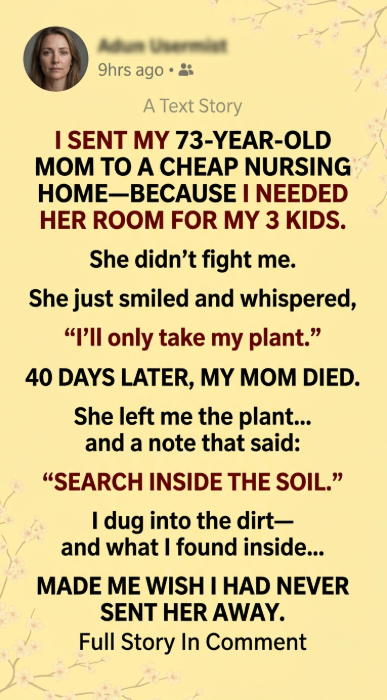
I SENT MY 73-YEAR-OLD MOM TO A CHEAP NURSING HOME—BECAUSE I NEEDED HER ROOM FOR MY 3 KIDS.
She didn’t fight me.
She didn’t cry.
She simply stood in the doorway of her bedroom, looking at the little room where she’d lived for eleven years.
Then she smiled sadly and whispered,
“I’ll only take my plant.”
I nodded.
At the time, I convinced myself I was doing the right thing.
My three children needed space.
My husband had lost his job.
Money was tight.
And my mother’s room was the only bedroom large enough for all three kids.
The expensive nursing home was out of our budget.
So I found the cheapest one I could.
It wasn’t beautiful.
It wasn’t luxurious.
But I told myself she would be cared for.
Before she left, Mom picked up her favorite plant.
It was an old green plant she’d had for decades.
She carried it out herself.
Then she looked at me.
“Take care of it.”
“I will.”
She smiled.
“I know.”
Forty days later, the nursing home called.
My mother had died peacefully in her sleep.
I remember standing in my kitchen, staring at the wall.
I felt guilty.
But I was also relieved.
There was no longer a monthly nursing-home bill.
No more arguments about her room.
No more worry.
At least that’s what I told myself.
Two days after the funeral, I noticed her plant sitting in the corner of my living room.
I almost threw it away.
Then I remembered what she’d said.
“Take care of it.”
I watered it.
That’s when I noticed something strange.
There was a small piece of paper tucked beneath the pot.
My mother’s handwriting.
My hands began to shake.
It said:
“SEARCH INSIDE THE SOIL.”
I stared at the words.
Then I carried the plant outside.
I grabbed a small shovel.
And I started digging.
At first, I found nothing.
Just roots.
Dirt.
Then the shovel hit something hard.
Clink.
I froze.
I dug around it with my hands.
It was a small metal box.
I opened it.
Inside was a key.
A photograph.
And several folded documents.
The photograph showed my mother when she was young.
But she wasn’t alone.
Standing beside her was a man I’d never seen before.
On the back, she’d written:
“Your father before you knew him.”
I stared at the photograph.
My father had died when I was six.
I’d spent my entire life believing he had been a poor factory worker who left us with almost nothing.
But the documents told a different story.
My father had owned a small construction company.
And according to the records, it had been worth millions.
I couldn’t understand.
Where had all the money gone?
Then I found a letter.
My mother’s handwriting filled the page.
She explained that my father had secretly placed the majority of his wealth into a trust for me.
But after his death, my uncle had convinced my mother to sign documents giving him control of the trust.
He promised to protect the money until I turned twenty-five.
Instead, he stole almost all of it.
My mother had spent years trying to recover what was left.
And she’d finally succeeded.
The key in the box opened a safety-deposit box.
The next morning, I went to the bank.
Inside that box was something I never expected.
$780,000 in certificates and bonds.
There was also another letter.
This one was addressed to me.
I opened it with trembling hands.
My mother wrote:
“I wanted to give this to you while I was alive, but I needed to know what kind of person you had become.”
I stopped reading.
My eyes filled with tears.
She continued:
“When you sent me away, I realized you had forgotten something your father taught me.”
“Money can replace a room.”
“It can replace furniture.”
“It can even replace a house.”
“But it can never replace the person you pushed out of it.”
I couldn’t breathe.
Then came the sentence that destroyed me.
“I wasn’t angry that you needed my room. I was hurt that you no longer needed me.”
I sat on the bank floor crying.
Then I read the final paragraph.
“The money is yours. But don’t use it to make your life bigger.”
“Use it to make your heart bigger.”
“Take care of your children.”
“And if you ever have to choose between having more space and making room for someone you love…”
“Make room.”
I went home and walked into my mother’s old bedroom.
My children were playing inside.
The room I’d taken from her.
I sat on the floor.
And for the first time, I understood.
I hadn’t sent my mother away because there was no room.
I’d sent her away because I’d convinced myself that her place in my life was negotiable.
The money she left me could have changed everything.
But I didn’t use it to buy a bigger house.
Instead, I found a better nursing home and established a fund for elderly residents who couldn’t afford one.
Then I kept my mother’s plant.
I moved it into the brightest room in the house.
Years later, it grew taller than I was.
My children called it Grandma’s Tree.
Whenever someone asked why I kept an old plant that should have been thrown away years ago, I always gave the same answer.
Because my mother left me more than money.
She left me a final lesson.
And every time I looked at that plant, I remembered the words buried beneath its roots:
Sometimes the thing we think is taking up too much space is the very thing holding our family together.