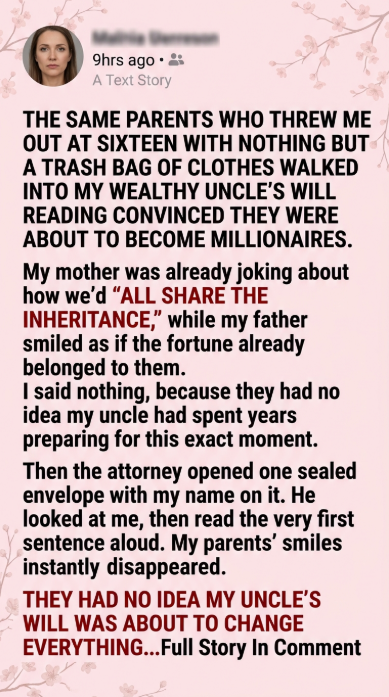
The same parents who threw me out at sixteen with nothing but a trash bag of clothes walked into my wealthy uncle’s will reading convinced they were about to become millionaires.
My mother was already smiling.
“We’ll all share the inheritance,” she said casually.
My father nodded as if the money already belonged to him.
I said nothing.
Because they had no idea my uncle had spent years preparing for this exact moment.
And neither did they know what he had written in his will.
Sixteen years old.
That was how old I was when my parents decided I was no longer their problem.
My mother packed my clothes into a black trash bag.
My father stood by the front door with his arms crossed.
“You’re old enough to figure things out yourself,” he said.
I remember looking at them and asking,
“Where am I supposed to go?”
My mother didn’t answer.
My father opened the door.
“Just go.”
I walked away carrying everything I owned in one hand.
I spent that first night on a friend’s couch.
The next morning, I started working.
I finished high school.
I went to community college.
I worked two jobs.
And slowly, painfully, I built a life without them.
My uncle Michael was the one person in my family who never treated me like a burden.
He called me every Sunday.
Sometimes he brought groceries.
Sometimes he simply sat with me and listened.
“You’re going to be okay,” he’d always say.
“You’re stronger than you think.”
He never talked much about money.
He owned several businesses and had accumulated considerable wealth, but he lived quietly.
He drove the same old truck for years.
He wore the same watch my grandfather had given him.
And whenever I thanked him for helping me, he’d wave it away.
“I didn’t do anything special.”
“You gave me a place to stay when nobody else would.”
He would smile.
“That’s what family is supposed to do.”
Then, when I was twenty-nine, Uncle Michael died unexpectedly.
The funeral was small.
I cried harder than I expected.
Not because of the money.
Because he was the closest thing I had ever had to a parent who chose me.
A week later, we gathered at his attorney’s office for the reading of his will.
My parents arrived dressed like they were attending a business meeting.
My mother whispered to me,
“Well, I suppose this is the moment we finally put everything behind us.”
I looked at her.
“What do you mean?”
She smiled.
“Don’t be difficult. We’re family.”
Then she leaned toward my father.
“We’ll all share the inheritance.”
My father laughed.
“Michael always said family comes first.”
I almost laughed myself.
They hadn’t spoken to me properly in years.
Now suddenly, we were family again.
The attorney entered carrying a thick folder.
Everyone became quiet.
He began reading the standard portions of the will.
A few personal belongings.
Several charitable donations.
Gifts to former employees.
Then came the business holdings.
My father’s smile grew wider.
My mother’s fingers clasped together.
She whispered,
“This is going to be enormous.”
The attorney paused.
Then he picked up a sealed envelope.
It had my name written across the front.
He looked directly at me.
“Your uncle left specific instructions that this letter be read aloud in the presence of everyone named in the will.”
My mother frowned.
“Why would there be a separate letter?”
The attorney opened the envelope.
He looked at me.
Then he read the first sentence.
“TO THE DAUGHTER MY BROTHER CHOSE TO ABANDON, I WANT YOU TO KNOW THAT I NEVER DID.”
The room went completely silent.
My mother’s face changed.
My father stopped smiling.
The attorney continued.
Michael had written that he had watched what happened to me when I was sixteen.
He had wanted to take me in permanently.
But I had begged him not to start a war with my parents.
So instead, he helped me quietly.
He paid for my first semester of college.
He helped me buy my first car.
He secretly deposited money into an account for emergencies.
And he kept every letter I had ever sent him.
Then came the part my parents had been waiting for.
The inheritance.
My uncle had not divided his estate equally.
He had left the majority of it to me.
His businesses.
His investment accounts.
His property.
And a trust worth several million dollars.
My mother shot to her feet.
“That can’t be right!”
The attorney calmly replied,
“It is.”
My father slammed his hand against the table.
“He was my brother!”
The attorney looked at him.
“And the will specifically states that your brother’s relationship to the beneficiary is irrelevant to the distribution.”
My mother stared at me.
“But we’re her parents!”
I finally spoke.
“You were.”
She looked stunned.
My father demanded to know why Michael would leave everything to me.
The attorney opened another document.
“This explains why.”
It was a handwritten letter.
Michael had written it two months before his death.
The attorney read:
“WHEN SHE WAS SIXTEEN, YOU GAVE HER A TRASH BAG AND TOLD HER TO LEAVE. I GAVE HER SOMETHING DIFFERENT. I GAVE HER A CHANCE.”
My mother began crying.
Not because she regretted losing me.
Because she realized she had lost access to the fortune she thought was hers.
The attorney continued.
“I HAVE WATCHED HER BUILD A LIFE WITHOUT ASKING ANYTHING FROM EITHER OF YOU. SHE WORKED FOR EVERYTHING SHE HAS. SHE NEVER ONCE ASKED ME TO PUNISH YOU. SO I WON’T.”
Then came the final paragraph.
“BUT I WILL MAKE SURE SHE NEVER HAS TO BE THROWN OUT AGAIN.”
I couldn’t hold back my tears.
For years, I had believed my uncle’s greatest gift was the help he gave me when I was sixteen.
I realized that day it had been something much bigger.
He had believed in me before I believed in myself.
My parents left the attorney’s office without saying goodbye.
My mother stopped at the door.
For a moment, I thought she might apologize.
Instead, she turned around and said,
“You’re really going to keep all of it?”
I looked at her.
“No.”
She smiled slightly.
Then I finished my sentence.
“I’m going to use it to build the family I wish I had.”
Years later, I created a scholarship fund in my uncle’s name for teenagers who had been forced out of their homes.
The first scholarship recipient was a sixteen-year-old girl who had nowhere to go.
I gave her the same advice my uncle once gave me.
“You’re going to be okay.”
“You’re stronger than you think.”
And when she asked me why I was helping her, I smiled.
“Because somebody once helped me.”
My parents never became millionaires.
But I did become something they never expected.
Independent.
Successful.
And completely free from the people who once convinced me I wasn’t worth keeping.
My uncle didn’t just leave me an inheritance.
He left me proof that being rejected by someone doesn’t mean you’re unworthy of being loved.
Sometimes the person who throws you away is simply making room for the person who will teach you your true value.