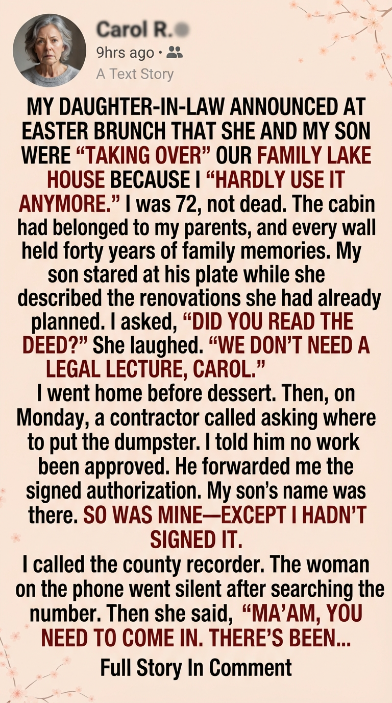
MY DAUGHTER-IN-LAW ANNOUNCED AT EASTER BRUNCH THAT SHE AND MY SON WERE “TAKING OVER” OUR FAMILY LAKE HOUSE BECAUSE I “HARDLY USE IT ANYMORE.”
I was 72, not dead.
The cabin had belonged to my parents, and every wall held forty years of family memories.
My son stared at his plate while his wife described the renovations she had already planned.
New kitchen.
New floors.
A deck overlooking the lake.
She even had paint samples.
I finally asked,
“DID YOU READ THE DEED?”
She laughed.
“WE DON’T NEED A LEGAL LECTURE, CAROL.”
I looked at my son.
He wouldn’t meet my eyes.
I went home before dessert.
I thought that was the end of it.
I was wrong.
Monday morning, my phone rang.
A contractor asked me where I wanted the dumpster delivered.
I said,
“I didn’t approve any work.”
He sounded confused.
“Your son authorized everything.”
He forwarded me the paperwork.
I opened the attachment.
There was my son’s signature.
Then I saw mine.
Except I hadn’t signed it.
My stomach dropped.
I immediately called the county recorder.
I gave the woman the parcel number.
She searched.
Then she went completely silent.
Finally, she said,
“MA’AM, YOU NEED TO COME IN. THERE’S BEEN A RECENT FILING ON THE PROPERTY.”
“What kind of filing?”
Another pause.
“A deed transfer.”
My hands went cold.
“To whom?”
She lowered her voice.
“Your son and his wife.”
I drove to the county office immediately.
The clerk pulled up the record.
According to the filing, I had transferred ownership of the lake house to my son six weeks earlier.
There was a notarized signature.
My signature.
And a witness.
I stared at it.
“I never signed this.”
The clerk looked at me carefully.
“Then you need an attorney.”
I did exactly that.
My attorney examined the document.
Then he noticed something I hadn’t.
The notary stamp belonged to a woman who had retired two years earlier.
The notary number was invalid.
The witness signature was also suspicious.
But there was something else.
The document had been filed electronically using an account connected to my son’s email address.
My attorney looked at me.
“Did your son ever have access to your personal documents?”
I thought about it.
Then remembered something.
Last year, after my husband died, my son had helped me organize paperwork.
He had scanned copies of my driver’s license, passport, and old property documents.
I felt sick.
He had everything he needed to create a convincing fake transfer.
But why would he do this?
I confronted him.
He didn’t deny it.
Instead, he said,
“Mom, we weren’t trying to steal the cabin.”
I stared at him.
“You filed a fake deed transferring my property to yourself.”
He looked down.
“We were trying to protect it.”
“From what?”
He finally admitted the truth.
His wife had accumulated enormous debt.
Creditors were already coming after them.
They believed that if they transferred the cabin into their names, they could sell it, pay off the debts, and keep the rest.
I couldn’t believe what I was hearing.
“You were going to sell my parents’ home?”
My son started crying.
“I thought you’d understand.”
I shook my head.
“No. You thought I’d forgive you.”
That was the difference.
The county froze the fraudulent filing while the matter was investigated.
The contractor canceled the renovation.
The fake deed was eventually voided.
But then the investigation uncovered something even worse.
My daughter-in-law had been planning to sell the cabin before Easter.
The “renovation” wasn’t really a renovation.
It was preparation for a quick sale.
She had already contacted a real-estate agent.
There was even a draft listing.
LAKEFRONT FAMILY RETREAT — MOTIVATED SELLER.
The estimated sale price was nearly seven figures.
I stared at the number.
They weren’t trying to “take over” a family cabin.
They were trying to turn my parents’ memories into a cash payment.
I changed every lock.
I revoked my son’s access to the property.
And I made one final decision.
I put the cabin into a properly documented estate plan so nobody could ever attempt something like that again.
Months later, my son came to my house.
He stood on the porch for several minutes before knocking.
When I opened the door, he was holding something.
A photograph.
It was one of my parents standing in front of the lake house on the day they bought it.
He handed it to me.
“I found this in the cabin.”
I looked at the picture.
My mother was smiling.
My father had one arm around her.
For a moment, I remembered being a little girl there.
Summer mornings.
Fishing from the dock.
Christmases by the fireplace.
My son looked at me.
“I was wrong.”
I didn’t answer.
He continued.
“I kept telling myself it was just a house.”
I looked at the photograph.
“It was never just a house.”
He nodded.
“I know that now.”
I eventually forgave my son.
But forgiveness didn’t mean giving him another opportunity to betray me.
He never received ownership of the cabin.
He never received a key.
And he never again assumed that being my son gave him the right to decide what happened to something that belonged to me.
A year later, I stood on the dock at sunset.
The lake was completely still.
I looked back at the cabin.
Four generations had memories inside those walls.
And I realized something.
My daughter-in-law had been right about one thing.
I didn’t use the cabin as much as I once had.
But that didn’t mean it was hers.
And it certainly didn’t mean I was finished with it.
So I started going there every weekend.
I invited my grandchildren.
We cooked.
We fished.
We repaired the old porch.
And one summer evening, my son asked if he could join us.
I thought for a moment.
Then I handed him a fishing rod.
“Of course.”
He smiled.
“But remember something.”
“What?”
I pointed toward the cabin.
“YOU DON’T INHERIT A FAMILY’S MEMORIES BY FORGING THEIR NAME.”
He nodded.
And for the first time in a long time…
he understood.