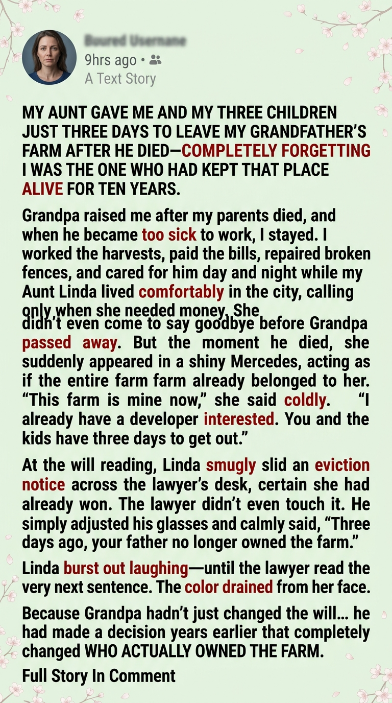
MY AUNT GAVE ME AND MY THREE CHILDREN JUST THREE DAYS TO LEAVE MY GRANDFATHER’S FARM AFTER HE DIED—COMPLETELY FORGETTING I WAS THE ONE WHO HAD KEPT THAT PLACE ALIVE FOR TEN YEARS.
Grandpa raised me after my parents died, and when he became too sick to work, I stayed.
I worked the harvests, paid the bills, repaired broken fences, and cared for him day and night while my Aunt Linda lived comfortably in the city, calling only when she needed money.
She didn’t even come to say goodbye before Grandpa passed away.
But the moment he died, she suddenly appeared in a shiny Mercedes, acting as if the entire farm already belonged to her.
“This farm is mine now,” she said coldly.
“I already have a developer interested. You and the kids have three days to get out.”
I didn’t argue.
I didn’t tell her she was wrong.
I just looked at my three children and said:
“Let’s go inside.”
Because Grandpa had taught me something years ago.
Never argue with someone who thinks they already know the truth.
Wait until they discover it themselves.
Three days later, we sat in the lawyer’s office for the reading of Grandpa’s will.
Linda arrived wearing an expensive suit.
She placed an eviction notice on the desk.
“There’s no reason to drag this out,” she said.
The lawyer didn’t even look at it.
He simply adjusted his glasses and said:
“Three days ago, your father no longer owned the farm.”
Linda burst out laughing.
“What are you talking about?”
The lawyer opened a thick folder.
“Mr. Harold Carter transferred ownership of the farm six years ago.”
Linda’s smile disappeared.
“To whom?”
The lawyer looked directly at me.
“To his granddaughter.”
Silence.
Linda stared at me.
“No.”
The lawyer continued.
“The property was transferred into a family agricultural trust. The sole beneficiary named in the trust is—”
He paused.
“Her.”
Linda stood up.
“You’re lying.”
The lawyer calmly pushed a document across the table.
It was a certified copy of the deed.
My name was on it.
I couldn’t speak.
I had no idea.
Linda snatched the paper.
“This is impossible.”
The lawyer shook his head.
“It was legally recorded six years ago.”
Linda looked at me.
“You knew?”
I shook my head.
“No.”
And I was telling the truth.
Grandpa had never told me.
All I knew was that six years earlier, he had asked me to sign some paperwork because he said he wanted to “protect the farm.”
I thought it was insurance paperwork.
I never imagined it was the deed.
Linda dropped back into her chair.
“But why would Dad do this?”
The lawyer looked at her.
“Because he knew exactly what you planned to do.”
Linda’s face changed.
“What does that mean?”
The lawyer opened another folder.
Inside were letters.
Bank statements.
Property evaluations.
And copies of emails.
Emails between Linda and a developer.
They had been negotiating the sale of the farm for almost eight months.
Eight months before Grandpa died.
I stared at her.
“You were already planning to sell it?”
Linda crossed her arms.
“Dad was old. Someone had to make decisions.”
The lawyer shook his head.
“No. Your father made the decision himself.”
He pulled out one final document.
It was dated six years earlier.
Grandpa had written a statement explaining why he transferred the property.
I recognized his handwriting immediately.
The lawyer read it aloud.
“I am not giving this farm to the person who visits me most.”
Linda looked away.
“I am giving it to the person who stayed.”
My eyes filled with tears.
The lawyer continued.
“For ten years, my granddaughter has worked this land, cared for my animals, paid my medical bills, repaired what I could no longer repair, and raised her children under this roof.”
I covered my mouth.
Grandpa had noticed everything.
Every late night.
Every harvest.
Every bill.
Every sacrifice.
Then came the sentence that broke me.
“If anyone tries to tell her she did not earn this place, remind them that she already did.”
Linda suddenly stood.
“I want to see the trust.”
The lawyer handed it to her.
She read page after page.
Then her face became pale.
Because Grandpa had included one more condition.
The farm could not be sold to a developer for fifteen years.
Instead, it had to remain agricultural land.
Linda slammed the document onto the table.
“He knew about the developer.”
“Yes,” the lawyer said.
“He knew about the offer.”
“Yes.”
“He knew I wanted to sell it.”
“Yes.”
She looked at me.
“Why didn’t he tell me?”
The lawyer answered quietly.
“Because he didn’t trust you with the truth.”
Linda’s face went red.
“You think she deserves this more than I do?”
The lawyer didn’t answer.
I did.
“I don’t think I deserve it because I’m better than you.”
I looked at the deed.
“I think Grandpa gave it to me because I stayed.”
Linda left the office without another word.
I thought that was the end.
It wasn’t.
That evening, the lawyer called me.
“There is something else your grandfather wanted you to have.”
He asked me to return to his office.
This time, he gave me a small wooden box.
Inside was an old key.
And a note.
My name was written across the envelope.
I opened it.
Inside, Grandpa had written:
“There’s something beneath the old barn.”
My heart started pounding.
The next morning, I took my children to the barn.
We searched for nearly an hour.
Finally, my youngest noticed that one section of the floor sounded hollow.
We moved the old feed bags.
Underneath was a wooden trapdoor.
The key fit.
Below it was a small storage room.
Inside were boxes.
Thousands of dollars in old farm records.
Seed contracts.
Land surveys.
Photographs.
And one envelope marked:
FOR HER CHILDREN.
Inside were three savings bonds and three letters.
One for each of my children.
Grandpa had been putting money aside for their education.
For years.
My oldest son started crying.
“He saved this for us?”
I nodded.
“He never forgot you.”
But there was one final document.
A letter addressed to me.
It said:
“You may think I left you a farm.”
“I didn’t.”
“I left you proof.”
“Proof that the work you do when nobody is watching still matters.”
I sat on the barn floor and cried.
For ten years, I had never known whether Grandpa noticed everything I was doing.
Now I knew.
He had noticed every single thing.
Months passed.
The developer eventually withdrew the offer.
Linda stopped calling.
But one winter evening, she appeared at my door.
She wasn’t wearing her expensive suit.
She looked tired.
“I need to apologize,” she said.
I didn’t invite her in immediately.
She continued.
“I thought Dad loved you more.”
I said nothing.
“He didn’t.”
I looked at her.
“He loved both of us.”
She started crying.
“He just knew you would protect what he built.”
That was the first honest thing she had ever said to me about the farm.
I eventually let her inside.
We sat at Grandpa’s old kitchen table.
She told me she had been drowning in debt and thought selling the farm would solve everything.
I didn’t give her money.
I didn’t give her the farm.
But I offered her something Grandpa had given me.
A chance to start over.
Years later, the farm was still producing crops.
My children grew up working beside me.
We restored the old barn.
We planted new trees.
And every spring, we placed a small wooden sign near the entrance.
It read:
HAROLD CARTER FARM
Underneath were four simple words:
KEPT ALIVE BY LOVE.
People sometimes ask me how I managed to inherit a farm worth so much.
They think the answer is the deed.
It isn’t.
The deed only proved ownership.
Grandpa had given me something much more valuable long before he died.
He gave me a reason to stay.
And when everyone else thought I was working for nothing, he was quietly making sure I would never have to leave.