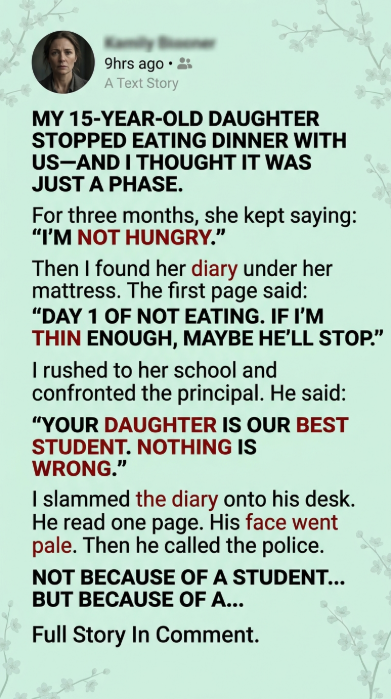
My 15-year-old daughter stopped eating dinner with us, and I thought it was just a phase.
For three months, she kept saying the same thing.
“I’m not hungry.”
Sometimes she would push food around her plate.
Sometimes she’d say she’d already eaten at school.
I believed her.
Teenagers change.
Teenagers become private.
Teenagers have moods.
At least, that’s what I told myself.
Then one Tuesday night, I found her diary under her mattress.
I shouldn’t have opened it.
But the first page made my hands freeze.
DAY 1 OF NOT EATING.
Underneath, she’d written:
IF I’M THIN ENOUGH, MAYBE HE’LL STOP.
I stopped breathing.
I turned the page.
Day 4. He said I looked better.
Day 9. He said nobody would believe me.
Day 17. He said if I tell Mom, he’ll make sure everyone knows what kind of girl I am.
Then I found the sentence that made my stomach turn.
HE SAID I’D LOSE EVERYTHING IF I TALKED.
I grabbed my keys.
My daughter was at school.
I drove there so fast I barely remember the trip.
I stormed into the principal’s office and put the diary on his desk.
“My daughter is starving herself because someone is threatening her.”
The principal frowned.
“Your daughter is our best student. Nothing is wrong.”
I slammed the diary down.
“READ IT.”
He opened the first page.
Then the second.
His expression changed.
By the third page, the color had drained from his face.
He looked at me.
“Where is your daughter right now?”
“In class.”
He immediately picked up the phone.
“Lock down her location. Don’t let her leave campus.”
Then he called the police.
I stared at him.
“Why are you calling the police?”
He lowered his voice.
“Because this isn’t about a student.”
He turned the diary toward me.
“This is about an adult.”
My heart pounded.
“Who?”
The principal swallowed.
“We’ve had complaints about someone making inappropriate contact with students.”
“Who?”
He didn’t answer immediately.
Then he whispered:
“The school counselor.”
Everything went silent.
Ms. Parker.
The woman my daughter had trusted.
The woman who had told me at parent conferences that my daughter was “mature for her age.”
The woman who had started asking my daughter to stay after school.
The woman who had sent me messages saying my daughter was “under unusual stress.”
I suddenly remembered something.
Three months earlier, my daughter had stopped eating.
Three months earlier, Ms. Parker had begun keeping her after school.
The principal called the police because the school had already been investigating several complaints.
But there was one problem.
There wasn’t enough evidence.
Until my daughter’s diary.
Police found messages between Ms. Parker and several students.
They found deleted messages recovered from a school device.
And then investigators discovered something even worse.
Ms. Parker had been targeting vulnerable students for years.
She told them they were “special.”
She convinced them not to tell their parents.
And when they tried to pull away, she threatened to spread private information about them.
My daughter’s diary wasn’t about wanting to be thin.
She had been trying to make herself invisible.
She thought if she changed her body enough, Ms. Parker would lose interest in her.
That realization destroyed me.
When I finally saw my daughter, she was sitting in a private room with a counselor.
The moment she saw me, she started crying.
“I’m sorry, Mom.”
I dropped to my knees.
“You don’t ever have to apologize for someone hurting you.”
She whispered:
“I thought you wouldn’t believe me.”
I hugged her.
“I believe you.”
For the first time in three months, she cried without trying to hide it.
She told investigators everything.
She told them about the meetings.
The messages.
The threats.
The things Ms. Parker had said to her.
And she gave them something else.
A small notebook containing the names of other students who had been afraid to speak.
That notebook became the beginning of a much larger investigation.
Ms. Parker was arrested.
Other families came forward.
The school brought in independent investigators and counselors.
And my daughter began receiving medical and psychological care for the damage she’d suffered.
Recovery wasn’t quick.
Some nights she still couldn’t eat.
Some mornings she looked at herself in the mirror and hated what she saw.
But slowly, she started healing.
We ate dinner together again.
At first, she only managed a few bites.
I never pressured her.
I just sat beside her.
One evening, months later, she put her fork down and smiled.
“I’m actually hungry.”
I smiled back through tears.
“Then let’s eat.”
She laughed.
And for the first time in a long time, our dinner table felt like a safe place again.
I kept her diary.
Not because I wanted to remember the pain.
But because I never wanted to forget what almost happened when I dismissed three months of “I’m not hungry” as a phase.
My daughter hadn’t been trying to disappear.
She had been trying to survive.
And the day she finally wrote the truth down…
someone finally listened.